Article
Caring for Large-Format Tile Comes Down to Grout, Cleaner and Rinse
In this article8 sections
- 01What does the remaining grout ask of you?
- 02Which cleaners are safe for the tile and the grout?
- 03What does safe disinfecting involve?
- 04Why does the rinse matter so much?
- 05What should you get in writing from the installer?
- 06Large-Format Tile Care Starts With the Maker’s Instructions
- 07Photo Gallery
- 08Cost Guides
Under ANSI A108.T, the 2023 American National Standard Terminology of Tile Assemblies, large-format tile is tile made to ANSI A137.1 with a facial dimension greater than 23 inches. The Tile Council of North America (TCNA) notes that large format tiles contribute less overall grout area, which leaves three things for the owner to control: the grout that remains, the cleaner and the rinse.
| Task | Use | Avoid |
|---|---|---|
| Routine cleaning | Warm water and mild soap, or a neutral-pH tile cleaner on matte finishes | Oil-based or wax-based cleaners, which leave a film |
| Stained grout | An alkaline cleaner, applied and then vacuumed up | Acids, which dissolve the cement in grout |
| Rinsing | Clean rinse water, then a wet vacuum or thorough drying | Leftover cleaner or puddles on the surface |
| Disinfecting | The product label’s directions, with windows and doors open | Mixing bleach with ammonia or any other cleaner |
What does the remaining grout ask of you?
The TCNA explains that cementitious grout is porous and can absorb a stain, so many owners choose to seal it, and that epoxy grout is virtually as stain proof as the tile. Ask the installer which grout and sealer were used, and keep those product names with the tile maker’s care sheet.
Which cleaners are safe for the tile and the grout?
Daltile’s care instructions for its Panoramic Porcelain slabs, an extra-large-format product, say regular cleaning with warm water and mild soap is sufficient, that matte porcelain should be cleaned with concentrated tile cleaners that have a neutral pH, and that cleaning products containing acids or ammonia should not be used because they can damage glossy surfaces.
The TCNA adds that grout is cement-based and dissolved by acids, so an alkaline cleaner suits it better than an acid one, and that oil-based or wax-based cleaners should not be used because grout absorbs them and keeps a waxy or oily film. It also says that removing stubborn stains with straight vinegar or a stronger acid is not recommended by the grout manufacturers, because regrouting is sometimes the result. The makers differ on products, so follow the sheet for your own tile where it disagrees with general advice.
What does safe disinfecting involve?
For disinfecting, the CDC’s bleach guidance says never to mix bleach with ammonia or any other cleaner, to open windows and doors when using products indoors, and to wear rubber or other non-porous boots, gloves and eye protection.
Why does the rinse matter so much?
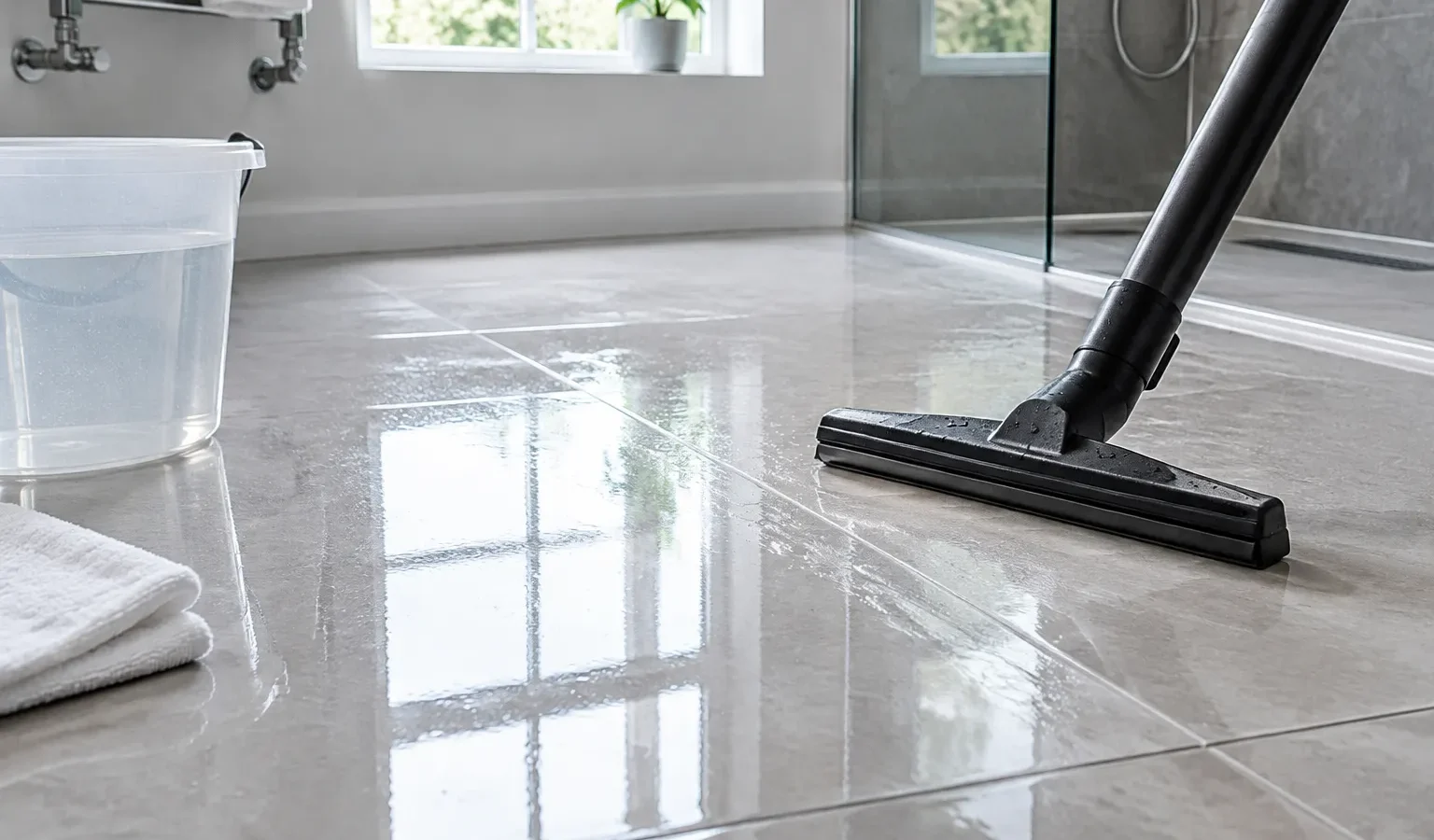
The TCNA says even good alkaline cleaners leave a sticky soap film if they are not rinsed properly, and that the film attracts dirt. Its best method is to apply the cleaner, vacuum up the dirty water with a shop vacuum, then apply rinse water and vacuum that up as well. Daltile adds that porcelain should always be dried thoroughly after cleaning, without leaving puddles. On a large, unbroken surface, a leftover film can be easier to notice.
What should you get in writing from the installer?
Ask for the tile maker’s written care instructions, the names of the grout and any sealer, and the date the grout was sealed, and keep them with your project records. The sealer’s maker sets how often grout should be resealed, so the product name and the date let you check the interval later.
Large-Format Tile Care Starts With the Maker’s Instructions
Fewer grout lines do not mean fewer rules: the cleaner, the rinse and the grout still decide how the surface looks years later. Start with what the manufacturer of your tile publishes, then use the TCNA and CDC guidance above to fill any gaps.
Photo Gallery








Cost guide
Bathroom Remodel Cost
United StatesNational ranges from what U.S. households paid contractors (Census American Housing Survey 2023). Full remodel is the upper quarter of hired projects. Prices as of August 2026. This is an estimate for planning, not a quote or a guaranteed Goodhaus price. Your actual cost depends on your home, your choices and your contractor, and quotes may be lower or higher. Open the cost calculator
Get Free QuotesCost guide
Kitchen Remodel Cost
United StatesNational ranges from what U.S. households paid contractors (Census American Housing Survey 2023). Full remodel is the upper quarter of hired projects. Prices as of August 2026. This is an estimate for planning, not a quote or a guaranteed Goodhaus price. Your actual cost depends on your home, your choices and your contractor, and quotes may be lower or higher. Open the cost calculator
Get Free Quotes