Article
Which Countertop Fits Your Kitchen Better, Quartz or Granite?
In this article8 sections
Choose quartz if you want a uniform look and the least routine care. Choose granite if you want a pattern no other kitchen has and better tolerance for hot pans. Both are hard, durable surfaces, so the decision usually rests on appearance, upkeep and how you cook rather than on a large difference in toughness.
Where each material wins
| Criterion | Quartz (engineered stone) | Granite (natural stone) |
|---|---|---|
| What it is | Crushed quartz bound with resin and pigment into slabs | Natural stone quarried and cut into slabs |
| Look | Uniform, repeatable patterns that match from slab to slab | Every slab is different, with natural variation in color and veining |
| Hot pans | The resin can scorch or discolor, so use trivets | Better tolerance, though trivets still help |
| Stains | Non-porous, so most spills wipe off | Resistant, and sealing can add protection |
| Routine care | Mild soap and water | Mild soap and water, with occasional sealing if you choose |
| Chips and scratches | Hard, but edges and corners can chip | Hard, but edges and corners can chip |
| Repairs | Small chips can be filled, with some risk of a visible color difference | Small chips can be filled, and natural variation hides some repairs |
Quartz wins when you want a consistent look across a long run of counters, a surface that never needs sealing and a busy kitchen where spills sit for a while. Granite wins when you cook at high heat, want the character of natural stone and are comfortable with a little maintenance.
Questions that settle it
- Do you want every run of counter to match? Quartz repeats its pattern, while granite varies even within one slab.
- Do you set hot pots straight from the stove onto the counter? Granite forgives that habit more, but a trivet habit makes either material safer.
- Would you rather never think about sealing? Quartz asks for nothing, while granite leaves sealing as an option you can take or skip.
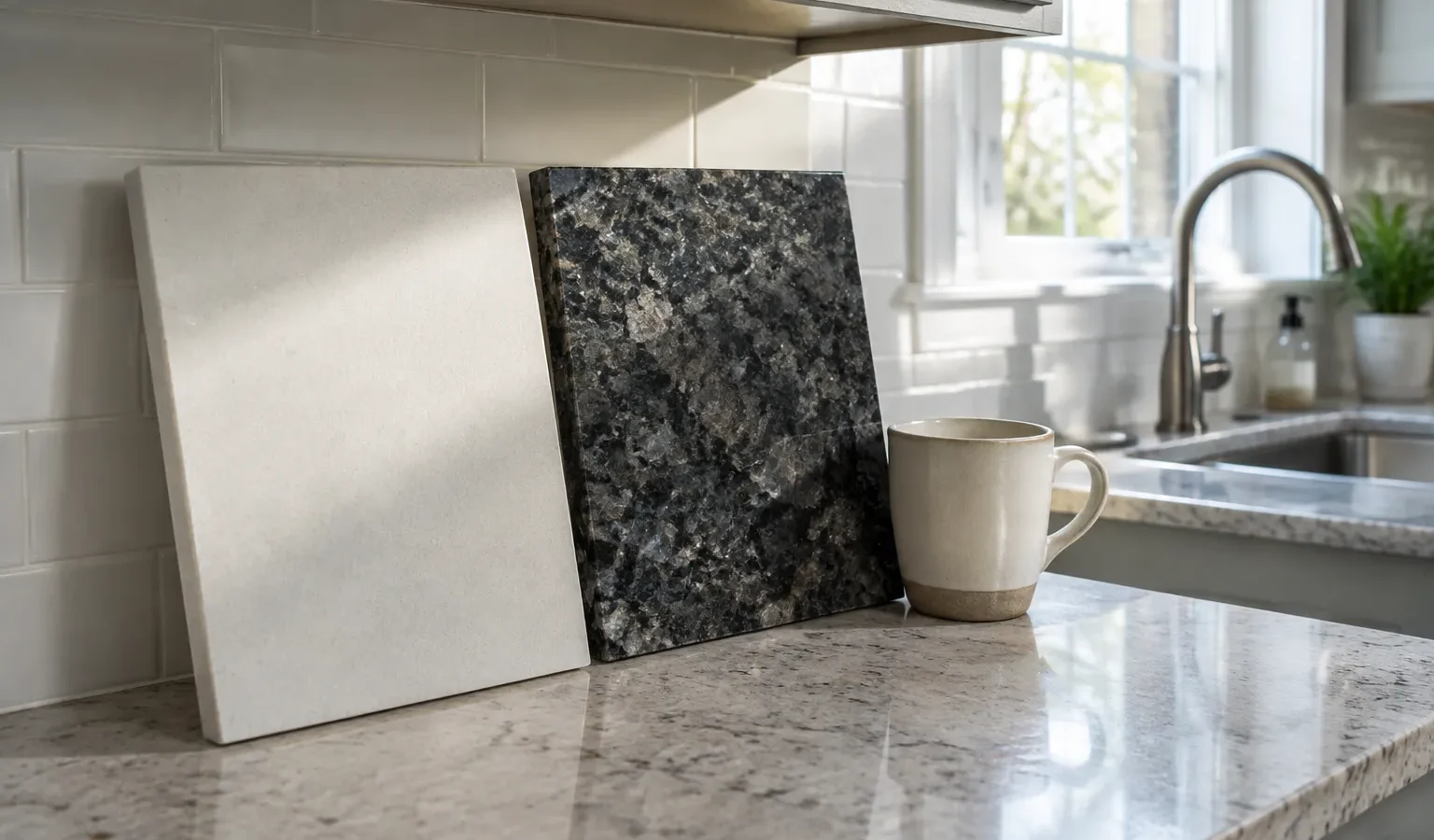
- Is the exact pattern part of why you want stone? Then choose granite and approve the specific slab, not a sample.
What daily care looks like
Neither surface needs special products for everyday cleaning. For granite, the Natural Stone Institute says most countertops do not need to be sealed and that cleaning after each meal prevents most staining, while noting that many benefit from a sealer that slows moisture from moving into the stone. For quartz, follow the maker’s own care sheet, because resin products can differ in how they handle heat and harsh cleaners.
What to inspect before you approve a slab
A small sample cannot show how a slab behaves across a whole counter. For granite, look at the full slab in person, because color and veining can shift from one end to the other. For either material, ask where the seams will fall and why, how the edge will be finished, and whether the sink cutout leaves enough stone at the corners to resist chipping.
A safety note about the people who cut the stone
Cutting either material releases fine silica dust. OSHA and NIOSH warn that workers who saw, grind, polish and drill natural and engineered stone slabs are at risk of silicosis, an incurable lung disease, and that finishing countertops involves similar tasks whichever material is used. Ask the fabricator how dust is controlled and whether sink and cooktop cutouts are made in the shop instead of in your kitchen.
Test samples against your own cooking habits
Bring home a sample of each and treat it the way your kitchen will: set a hot mug on it, leave a drop of oil and a splash of lemon juice overnight, then look at the result in your own light. A sample that shrugs off your habits is a better guide than any chart. When you collect kitchen remodeling quotes, ask each fabricator to price the same slab size, edge and cutouts so the numbers compare.
Photo Gallery
Cost guide
Bathroom Remodel Cost
United StatesNational ranges from what U.S. households paid contractors (Census American Housing Survey 2023). Full remodel is the upper quarter of hired projects. Prices as of August 2026. This is an estimate for planning, not a quote or a guaranteed Goodhaus price. Your actual cost depends on your home, your choices and your contractor, and quotes may be lower or higher. Open the cost calculator
Get Free QuotesCost guide
Kitchen Remodel Cost
United StatesNational ranges from what U.S. households paid contractors (Census American Housing Survey 2023). Full remodel is the upper quarter of hired projects. Prices as of August 2026. This is an estimate for planning, not a quote or a guaranteed Goodhaus price. Your actual cost depends on your home, your choices and your contractor, and quotes may be lower or higher. Open the cost calculator
Get Free Quotes