Article
What Causes Bathroom Mold, and When Should You Call a Pro?
In this article8 sections
Mold in a bathroom grows where a surface stays wet, and it comes back until the moisture source is fixed. The EPA says that a moldy area of less than about 10 square feet can in most cases be handled by the homeowner, while a lot of water damage, hidden growth or sewage-contaminated water calls for more than a household cleanup. The sections below separate the two.
Why does mold keep growing in my bathroom?
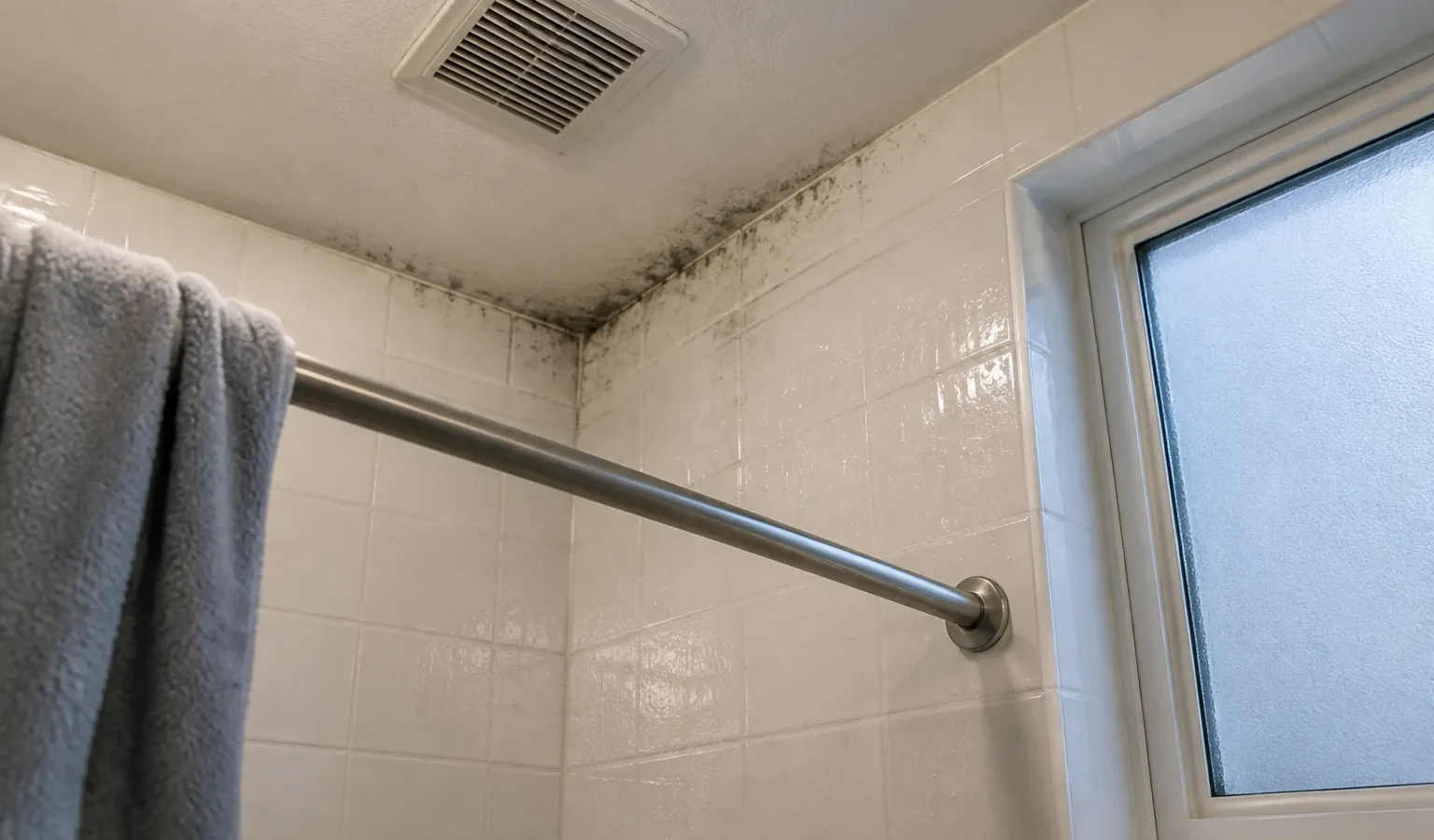
Mold spores float through outdoor and indoor air, and none of the many types of mold will grow without water or moisture. Showers, steam and splashes keep bathroom surfaces damp every day, and the EPA notes that places that are often or always damp can be hard to keep completely free of mold.
- A fan that is weak, blocked or never switched on, so steam settles on walls and ceiling.
- A slow leak at a supply line, drain, shower valve or window that keeps a hidden surface wet.
- Cracked grout or caulk that lets water behind tile.
- Wet towels and mats left in a closed room.
What can I clean myself?
The EPA says that if a moldy area is less than about 10 square feet, roughly a 3 ft. by 3 ft. patch, you can in most cases handle the job yourself.
- Fix the plumbing leak or other water problem first, then scrub mold off hard surfaces with detergent and water and dry them completely.
- Do not paint or caulk moldy surfaces, because paint applied over mold is likely to peel.
- Absorbent or porous materials such as ceiling tiles and carpet may have to be thrown away if they become moldy.
- For protection the EPA suggests an N-95 respirator that fits properly, long gloves and goggles without ventilation holes.
- Chlorine bleach is not recommended as a routine part of mold cleanup, and it must never be mixed with cleaners that contain ammonia because toxic fumes could be produced.
When should I stop and call a professional?
| What you find | What the EPA says | Your next step |
|---|---|---|
| Mold over more than about 10 square feet, or a lot of water damage | Consult the EPA’s guidance on mold remediation in schools and commercial buildings, which applies to other building types too | Get a professional assessment before you start |
| Sewage or other contaminated water caused the damage | Call in a professional who has experience with buildings damaged by contaminated water | Stop and call before touching it |
| A musty smell with no visible source, or damp walls around pipes | Hidden mold can be behind drywall, wallpaper or panels and around leaking pipes, and investigating it can release a large amount of spores | Consider hiring an experienced professional |
| Mold returns after you clean and dry the area | If you clean up the mold but do not fix the water problem, the mold will most likely come back | Find and repair the moisture source |
In most cases, if visible mold growth is present, sampling is unnecessary, so a test kit is rarely the first step.
How do I keep it from coming back?
- Run the bathroom fan or open the window when showering.
- Dry spills and leaks quickly, because if wet or damp materials are dried 24 to 48 hours after a leak or spill, in most cases mold will not grow.
- Keep indoor humidity below 60 percent, ideally between 30 and 50 percent.
- If mold keeps reappearing in the shower, increase ventilation and clean more frequently, which the EPA says will usually prevent it from recurring or keep it to a minimum.
Will a bathroom remodel get rid of it?
A remodel clears recurring mold only when it removes the moisture source, for example by adding a properly vented fan or repairing a leak behind the wall, so ask any bidder how the plan handles ventilation and water, not just surfaces.
Mold Comes Back Until the Water Problem Is Fixed
A bathroom that grows mold again and again is telling you where the water is going. If the source turns out to be behind a wall or under the tub, that is plumbing and building work, and you can request bathroom remodeling quotes from contractors who do it.
Photo Gallery





Cost guide
Bathroom Remodel Cost
United StatesNational ranges from what U.S. households paid contractors (Census American Housing Survey 2023). Full remodel is the upper quarter of hired projects. Prices as of August 2026. This is an estimate for planning, not a quote or a guaranteed Goodhaus price. Your actual cost depends on your home, your choices and your contractor, and quotes may be lower or higher. Open the cost calculator
Get Free QuotesCost guide
Kitchen Remodel Cost
United StatesNational ranges from what U.S. households paid contractors (Census American Housing Survey 2023). Full remodel is the upper quarter of hired projects. Prices as of August 2026. This is an estimate for planning, not a quote or a guaranteed Goodhaus price. Your actual cost depends on your home, your choices and your contractor, and quotes may be lower or higher. Open the cost calculator
Get Free Quotes